

An Absurdly Condensed Rundown on Earth's ENTIRE History
Cenozoic Era: 66 mya to today (~1.5% of Earth’s history)
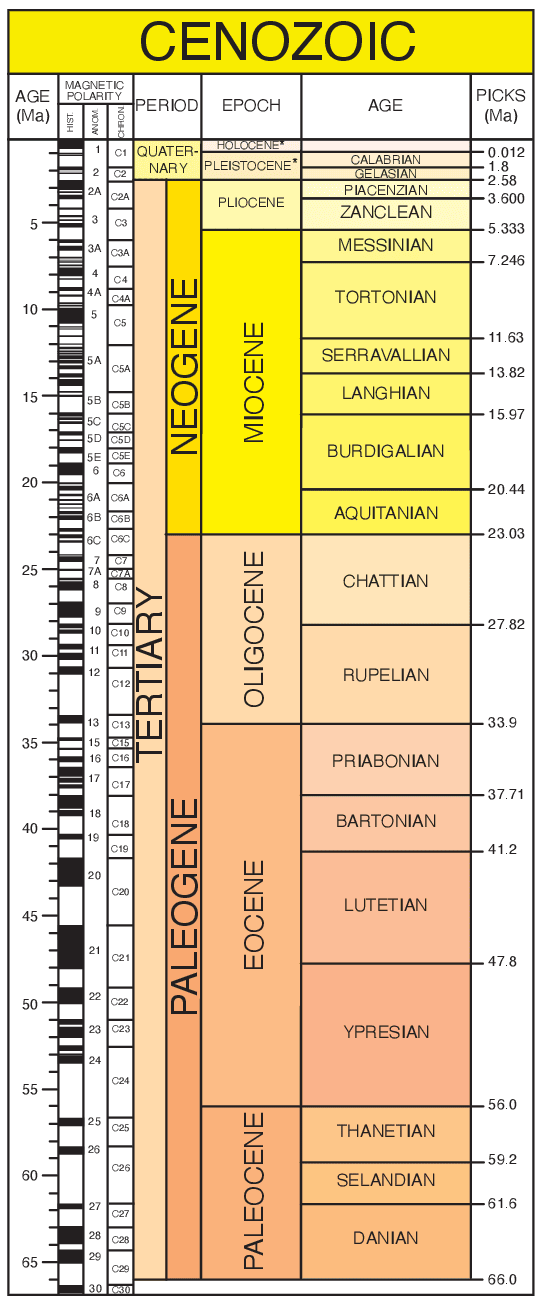
From the Greek words for new (kainos) and life (zoe), our modern era, the Cenozoic (sen-uh-ZOH-ick or see-nuh-ZOH-ick), started with a bang: the K-T or K-Pg (Cretaceous-Tertiary/Paleogene) extinction event, in which 70-80% of all plant and animal species disappeared from the fossil record (including the big one: non-avian dinosaurs).
The Cenozoic marked the flourishing of flowering plants (including, importantly, grasses), birds, and especially mammals, which thrived in the new ecological niches created by such a massive and sudden extinction event. Mammals in particular were able to take advantage of this new, [non-avian] dinosaur-free state of affairs, rapidly diversifying into a vibrant collection of marine, terrestrial, and flying animals. This intense and rapid speciation continued throughout the era, ultimately setting in motion what would eventually lead to the evolution of anatomically modern humans some 200- to 300,000 years ago.
Major geological changes also took place during the Cenozoic. As the tectonic plates drifted into their present locations, Gondwana experienced its final break up (as Antarctica split from South America and Australia); India slammed into Asia (forming the Himalayas); Arabia collided with Eurasia, closing the Tethys Ocean (vestiges of which still exist in the form of the Mediterranean, Caspian, and Black Seas); the Atlantic continued to widen; and the Isthmus of Panama was formed, connecting North and South America and shifting oceanic currents worldwide, hastening the coming ice ages of the Pleistocene epoch.
Climatically, the beginning of the Cenozoic was much warmer than today with ice free poles and sea levels ~300 meters (close to 1000’) higher than current levels. Then, ~50 mya, Earth entered a general long term cooling trend (with occasional warm periods mixed in), eventually leading to the extreme glaciations of the Pleistocene, the last of which ended only ~14,000 years ago.
The oldest fossils you’ll find in Florida are from the Eocene epoch and are around 50 million years old. The vast majority, however, are far younger, from the Miocene onward, topping out at 23 million years old. This sliver of time represents just .05% of Earth’s history, a mere blip on the radar.
Mesozoic Era: 252 - 66 mya (~4% of Earth’s history)
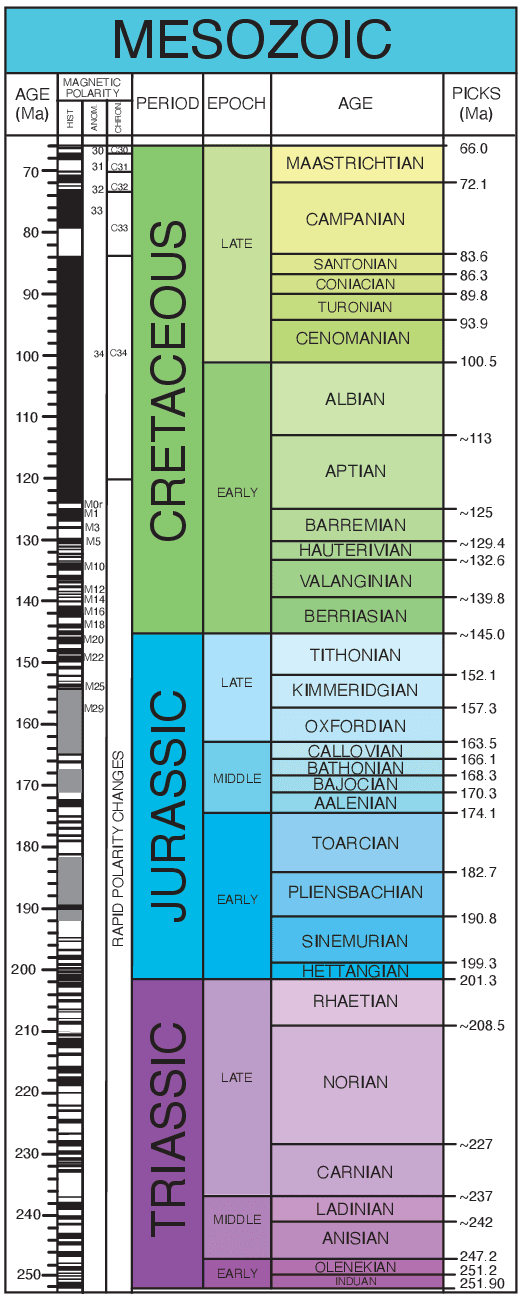
The Mesozoic era (mess-uh-ZOH-ick or mez-uh-ZOH-ick), from Greek middle (meso) and life (zoe), and comprising three periods – the Triassic, Jurassic, and Cretaceous – began with an even bigger bang than the Cenozoic: the P-Tr (Permian-Triassic) extinction event (also called the Great Dying). The most devastating mass extinction in Earth’s history, this cataclysm resulted in ~90% of all plant and animal species disappearing (including ~95% of marine species and ~70% of terrestrial species).
Out of the ashes of the Great Dying, reptiles came to dominate the earth. Plesiosaurs, ichthyosaurs, and later on mosasaurs flourished in the oceans while crocodilians out-competed the giant amphibians that had previously ruled the freshwater seas. Dinosaurs grew to terrifying sizes (though many species remained quite small) and became the preeminent terrestrial animals. Birds (avian dinosaurs) eventually evolved and would be the only dinosaurs to survive the coming K-T mass extinction. Mammals also evolved during this time, but remained small and limited in diversity until the Cenozoic. Modern forms of sharks evolved and insects first attained full metamorphosis. Conifers and ferns dominated lush, coastal forests (especially near the equator), with vast, highly seasonal deserts occupying much of the interior of the Pangean supercontinent. Another mass extinction took place, this time at the Triassic/Jurassic boundary, resulting in the disappearance of 70-75% of all species.
Pangea began rifting apart during the early Jurassic (~200 mya), breaking into Laurasia (North America, Europe, and Asia) and Gondwana (South America, Africa, Australia, New Zealand, India, Madagascar, and Antarctica) before fracturing further, with many land masses beginning to take on their modern shapes.
Global temperatures were generally much warmer, with a “greenhouse climate” in effect for much of the era. There was also far less variance in temperatures between the poles and equator than we see today.
Paleozoic Era: 541 - 252 mya (~6.5% of Earth’s history)
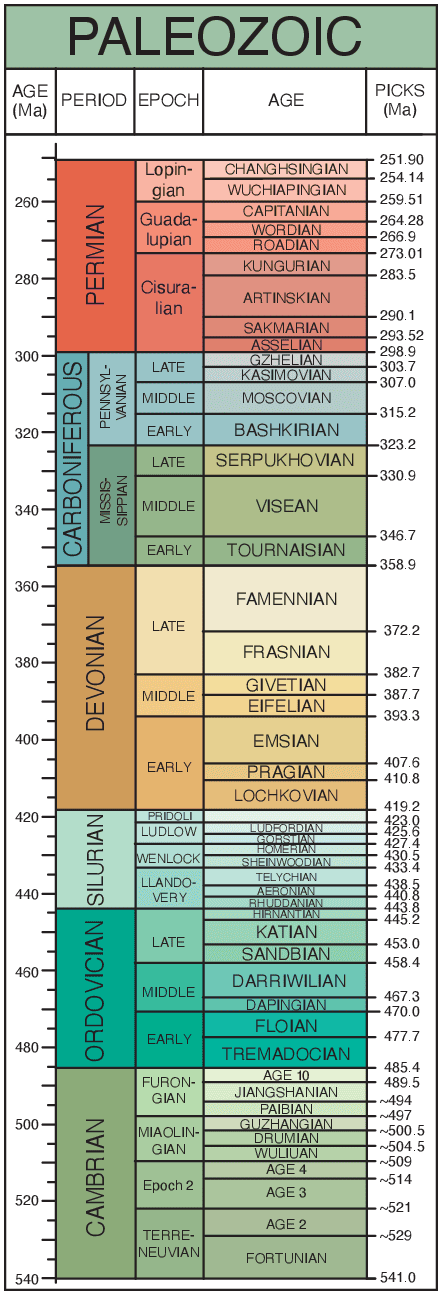
The Paleozoic era (PAY-lee-oh-ZOH-ick), from Greek palaios (old) and zoe (life), is the oldest era of the Phanerozoic eon, and consists of six periods: the Cambrian, Ordovician, Silurian, Devonian, Carboniferous (further split into the Mississippian and Pennsylvanian), and Permian. It started with the greatest and most widespread diversification of life in Earth’s history: the Cambrian explosion. It was during this time that vertebrates (animals with spinal columns, or backbones) first evolved, eventually branching off into fish, amphibians, reptiles, birds, and mammals over the ensuing millions to hundreds of millions of years.
The seas of the early Cambrian were teeming with life. Proto-fishes, arthropods (such as trilobites), worms, and algae flourished in shallow, coastal seas. Meanwhile, life on land was non-existent, save for small colonies of bacteria. It’s generally thought that rudimentary plants and animals first began colonizing land around 500 mya, although recent discoveries are pushing these numbers back even further. By the Silurian, leafless plants and centipede-like arthropods were widespread on the coasts. Meanwhile, the first proto-sharks evolved in the seas. In the Devonian, vertebrates managed to colonize land in the form of proto-amphibians, which evolved from air-breathing fish. 30’ tall fungi towered over the landscape, as trees had yet to evolve. In the Carboniferous, plants and animals became widespread on land, having evolved mechanisms which allowed them to overcome their reliance on moist environments for reproduction. Giant insects took to the air as the first flying animals (some with wingspans of over 3’). Lush forests that would ultimately become rich coal deposits formed across the globe. By the Permian, reptiles were becoming dominant and Pangea was fully formed.
Lasting for nearly 300 million years, the Paleozoic was a time of massive fluctuations in climate, as landmasses coalesced, broke apart, and drifted between the poles and equator. There were times of extreme warmth and high levels of atmospheric CO₂, times of near-global glaciation, and everything in between.
Precambrian Super-eon: 4.6 bya - 541 mya (~88% of Earth’s history)
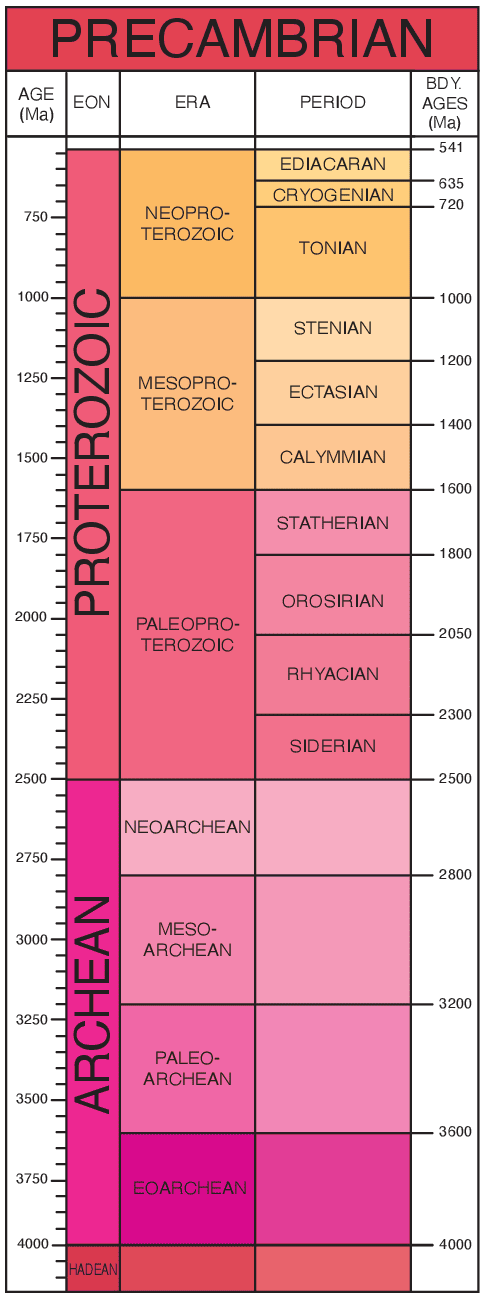
The Precambrian Super-eon covers the Proterozoic, Archean, and Hadean eons, a period of over 4 billion years and accounting for a whopping 88% of Earth’s history.
Fossils from this time are incredibly sparse (as animals didn’t form hard parts that fossilize well until after the Cambrian explosion) and most Precambrian rock is either deeply buried beneath younger strata, eroded away, or heavily metamorphosed and therefore of limited paleontological value. We think the earth coalesced from space detritus orbiting the sun some 4.6 bya, possibly smashing into another proto-planet and forming the moon early on in its existence. Zircon crystals in Australia have been dated to ~4.4 billion years, indicating that liquid water, an atmosphere, and a stable crust must have been in place by that point. These early years of Earth’s history were chaotic: the solar system was still forming and collisions with other celestial bodies was common; the atmosphere was an inhospitable mix of hydrogen, CO₂, and methane with a surface temp of 230℃ (nearly 450℉); and the air pressure at sea level was 27 times that of today – heavy enough to keep water liquid well past its boiling point.
Life is thought to have first started ~3.8 bya, in the form of anaerobic microbes. Eventually, ~2.7 bya, cyanobacteria came onto the scene. These microscopic, single-celled organisms (which still exist today) obtain energy through photosynthesis, releasing oxygen – something the atmosphere was devoid of at the time – in the process. Paradoxically, as oxygen gradually built up in the atmosphere over the ensuing hundreds of millions of years, it became toxic to most life on the planet. This set in motion a massive shift in the metabolism of early life forms from anaerobic to aerobic, and in their composition from unicellular to multicellular, which ultimately culminated in the explosion of life forms we saw as the Precambrian gave way to the Paleozoic.
