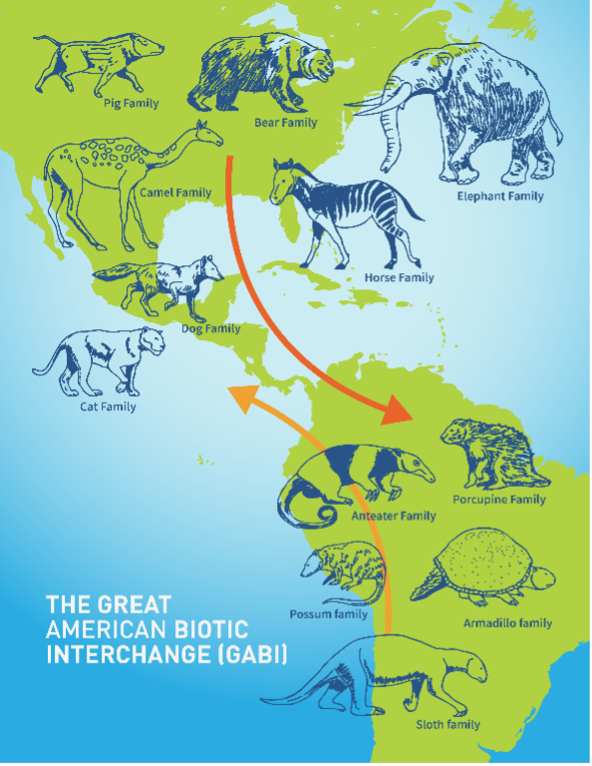
The Great American Biotic Interchange (GABI) was one of the most important dispersal events (the large-scale movement of animals into new habitats) of the last several million years.
Though increased tectonic activity in what is now Central America made it possible for certain species to “island hop” between North and South America (which had been isolated – an island continent – since the final breakup of Gondwana some 50 million years ago) via newly formed islands as early as 12 mya, the GABI reached its peak starting ~2.7 mya with the formation of the Isthmus of Panama. This newly formed land bridge allowed for tremendous dispersals of animal species between the two previously separated continents, effectively ending South America’s “splendid isolation” (Simpson, 1980).
From the south came animals such as armadillos, glyptodonts, ground sloths, terror birds, porcupines, and opossums, only a few of which persist into modern times, while northern emigrants included cats, dogs, bears, elephants, horses, llamas, tapirs, and more, many of which are now thought of as quintessential South American fauna (eg, jaguars, llamas, and tapirs).
In general, North American fauna thrived in South American ecosystems, outcompeting many of the continent’s endemic (native; found only in one place) species. Having evolved in isolation, these native animals were ill-equipped to handle the sudden influx of ecologically robust North American competitors – species that had already spent millions of years exchanging and competing with Eurasian and African lineages via the Bering Land Bridge. Today, roughly half of all modern mammal species in South America have North American origins, while only about ten percent of northern species can trace their lineages southward.