

What is the Pleistocene?
The Pleistocene (PLY-stuh-seen) is the most recent epoch (EH-pick or EE-pok; the second shortest division of the geologic time scale – shorter than a period but longer than an age – typically lasting hundreds of thousands to tens of millions of years) of the Cenozoic (sen-uh-ZO-ick) Era. It was preceded by the Pliocene (PLY-uh-seen) and followed by our current epoch, the Holocene (HA-luh-seen), and lasted from 2.58 million to just 11,700 years ago.
More commonly known as the “Ice Age,” the Pleistocene marked a transition to, on average, significantly cooler global temperatures – a state climatologists call an icehouse earth. These colder conditions led to repeated glaciations, where vast ice sheets radiated outward from Earth’s poles, at times covering up to 33% of the planet’s land surface with ice as much as 2.5 miles thick. Extending as far south as Missouri, these glaciers scoured and reshaped the landscape as they advanced and retreated, carving out features such as the Great Lakes in the process.
Over its ~2.6 million years, the Pleistocene saw at least 17 major glacial (cold) and interglacial (warm) cycles – likely more. The last glacial period ended about 14,000 years ago, while the previous interglacial occurred roughly 130,000–115,000 years ago (technically we’re in another interglacial right now). During this time, Florida was up to twice as wide as it is today (as sea levels were up to 400’ lower) and had a climate similar to that of modern day Kentucky – 5-10℉ cooler on average and significantly less humid.
What are megafauna?
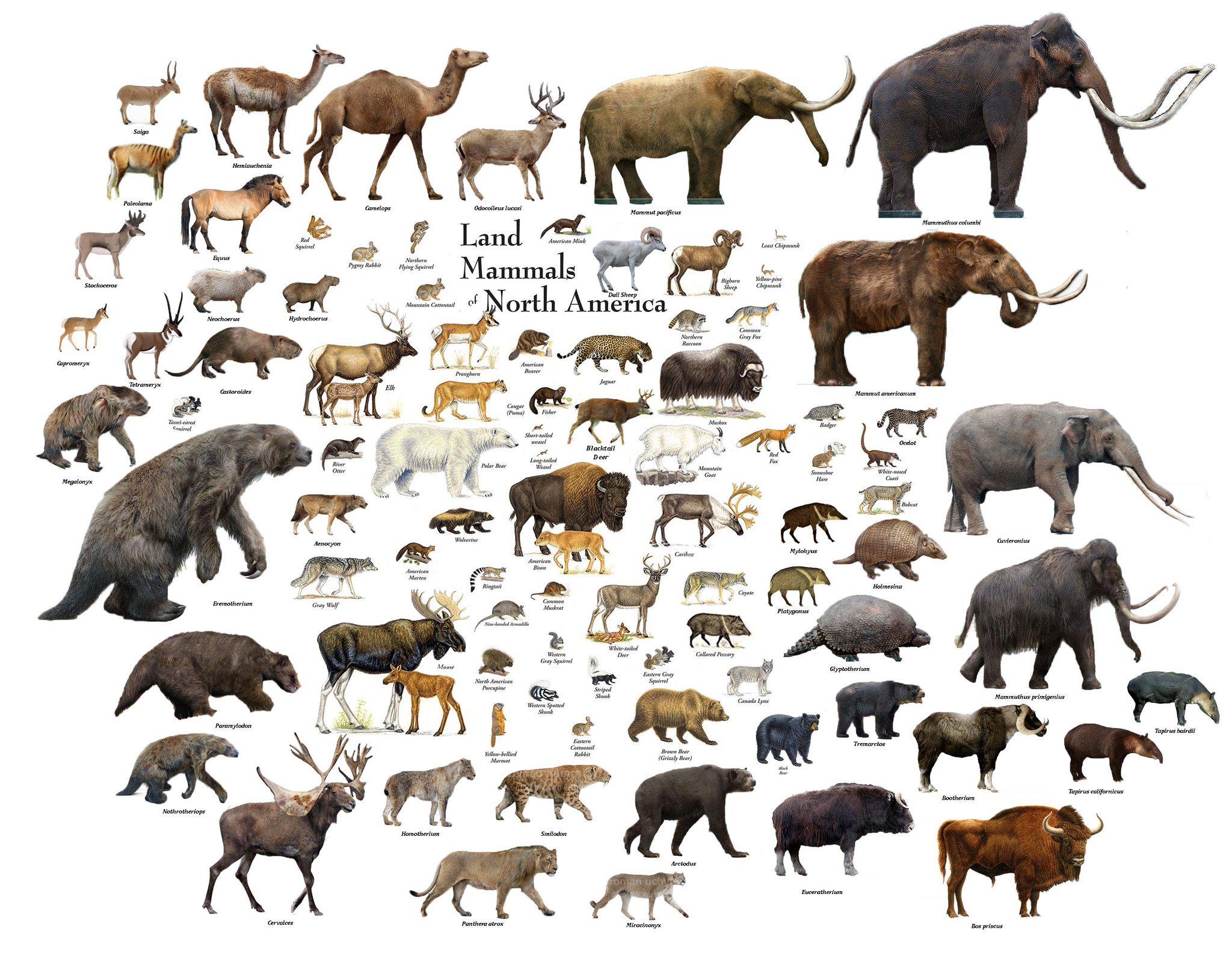
The term megafauna typically refers to any animal species that averages at least 100 lbs (46 kg) as an adult (this of course includes humans). The Pleistocene was notable for its terrestrial (land-dwelling) mammalian megafauna in particular.
No longer kept in “ecological check” by the typically larger and more robustly established (ecologically speaking) dinosaurs after their extinction at the end of the Mesozoic era, mammals flourished during the Cenozoic, occupying and dominating niches previously unavailable to them. Though maximum terrestrial mammalian sizes had already been achieved some ~30 mya, this class of animals continued to diversify into the staggering assortment of orders, families, genera, and species we found during the Pleistocene, many of them truly enormous. But then, toward the end of the epoch…something happened. Over the past ~50,000 years nearly 65% of megafaunal species worldwide have gone extinct, with the Americas, Eurasia, and especially Australia taking the brunt of these losses.
So…what happened?
In short, we’re not completely sure. What we do know is that these extinctions were probably caused by a variety of factors, with human predation, habitat disruption, and rapid climate shifts all playing roles to varying degrees.
Megafauna are particularly sensitive to extinction events, as large overall size correlates to long gestation times (the time it takes an embryo to develop in the womb), long sexual maturation times (the age at which reproduction becomes possible), and a tendency to produce only a single offspring in any given reproduction cycle, meaning they’re not able to rebound as quickly as smaller animals after shocks to the status quo. While it can take millions of years for populations to flourish, they can sometimes be decimated in a matter of decades.
