

From Pangea to Orange Island, ~335 - 30 mya
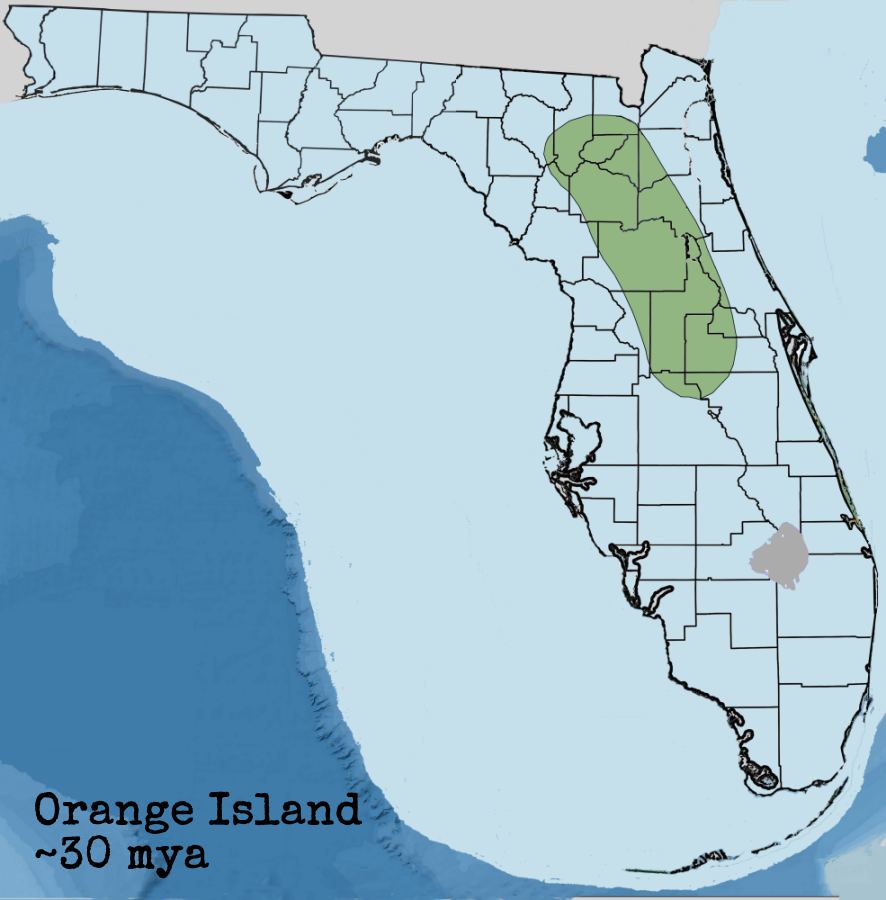
Florida’s origin story is an unexpected one: its basement rock (the deepest and most ancient crustal rock it sits on) was originally part of the African continental plate! During the assembly of Pangea (335-300 mya), however, this block of crust was effectively welded onto the edge of the North American plate, where it remained as the supercontinent later broke apart and the Atlantic Ocean opened (~200-180 mya).
Over the ensuing 150+ million years, “proto-Florida” existed as a vast, shallow carbonate platform, or a warm, coral-rich marine environment similar to the Bahamas today. As countless generations of corals and other marine organisms lived, died, and broke apart, their remains accumulated as layer upon layer of carbonate sediment, eventually hardening into the limestone deposits that form Florida’s bedrock (the solid rock layer closest to the surface).
Then, as the global climate cooled during the early to mid Oligocene epoch (33.9–23 mya), sea levels fell, exposing the highest parts of this ancient platform in what’s now north-central Florida. These scattered uplands formed Orange Island, the earliest landmass of what would eventually become the Florida we know today.
Florida during the early Miocene, ~23 mya
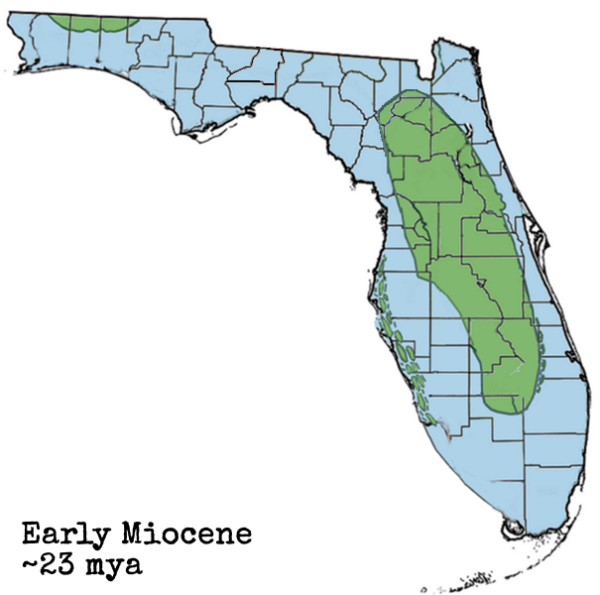
Over the next several million years, Orange Island continued its rise out of the sea, as this once scattered chain of isolated uplands gradually merged into a more continuous landmass – the earliest version of the peninsula was beginning to take shape.
Although the Miocene climate was significantly warmer on average than today, it was also a time of dramatic swings. During cooler intervals, global sea levels fell (called sea level lowstands), briefly exposing land bridges between Florida and the mainland. These temporary connections allowed waves of terrestrial mammals to disperse into the peninsula, where they were welcomed by expanding grassland savannas and mixed woodland forests. Among these early migrants were ancient relatives of horses, camels, rhinos, and mastodons, and their predators – bears, “bear-dogs,” “bone crushing dogs”, early saber-toothed cats, and more.
Meanwhile, Florida’s shallow, tropical seas remained some of the most biologically productive waters in North America. Coral reefs flourished offshore, giant sharks patrolled the continental shelf, and a wide array of marine mammals – including ancient dolphins, manatees, and whales – thrived in its warm coastal environments. These seas left behind the rich fossil deposits seen today in formations such as the Hawthorn Group, which records the transition from a mostly submerged platform to an emergent peninsula.
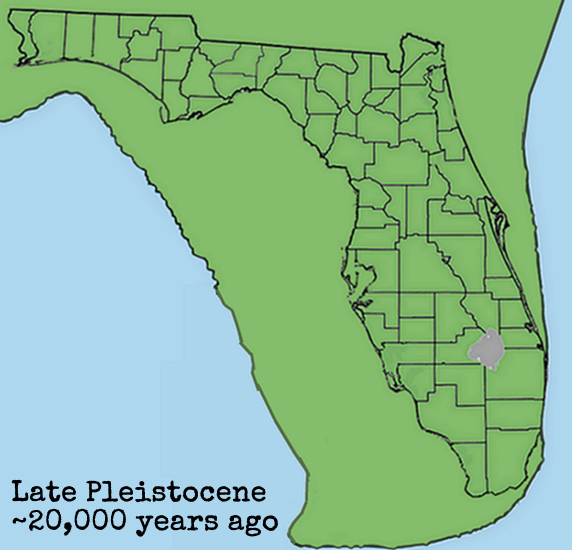
Florida during the late Pleistocene, ~20,000 years ago
More commonly known as the “Ice Age,” the Pleistocene epoch (2.58 million to 11,700 years ago) marked a transition to, on average, significantly cooler global temperatures – what climatologists call an icehouse earth.
During this time, massive continental ice sheets advanced and retreated in repeated glacial cycles, at their peak covering nearly one-third of Earth’s land area beneath ice up to 2.5 miles thick. With so much of the planet’s water locked away in ice, global sea levels plummeted – by as much as 125 meters (over 400 feet) during the last glacial maximum ~20,000 years ago – as Florida grew to roughly twice its modern size.
While these ice sheets never approached the peninsula, the cooler and drier Pleistocene climate created ideal conditions for one of the most extensive and varied megafaunal communities in North America. Florida’s Ice Age icons included mammoths and mastodons; horses, camels, and bison; giant ground sloths; and glyptodonts (armadillo relatives the size of small cars), all stalked by some of the most fearsome predators to ever live: dire wolves; saber-tooth cats; American lions; short-faced bears; and more.
