Happy Valentine’s Day and Welcome To Your Fossil Adventure!
What you have are REAL fossils from REAL prehistoric animals that lived up to 23 million years ago!
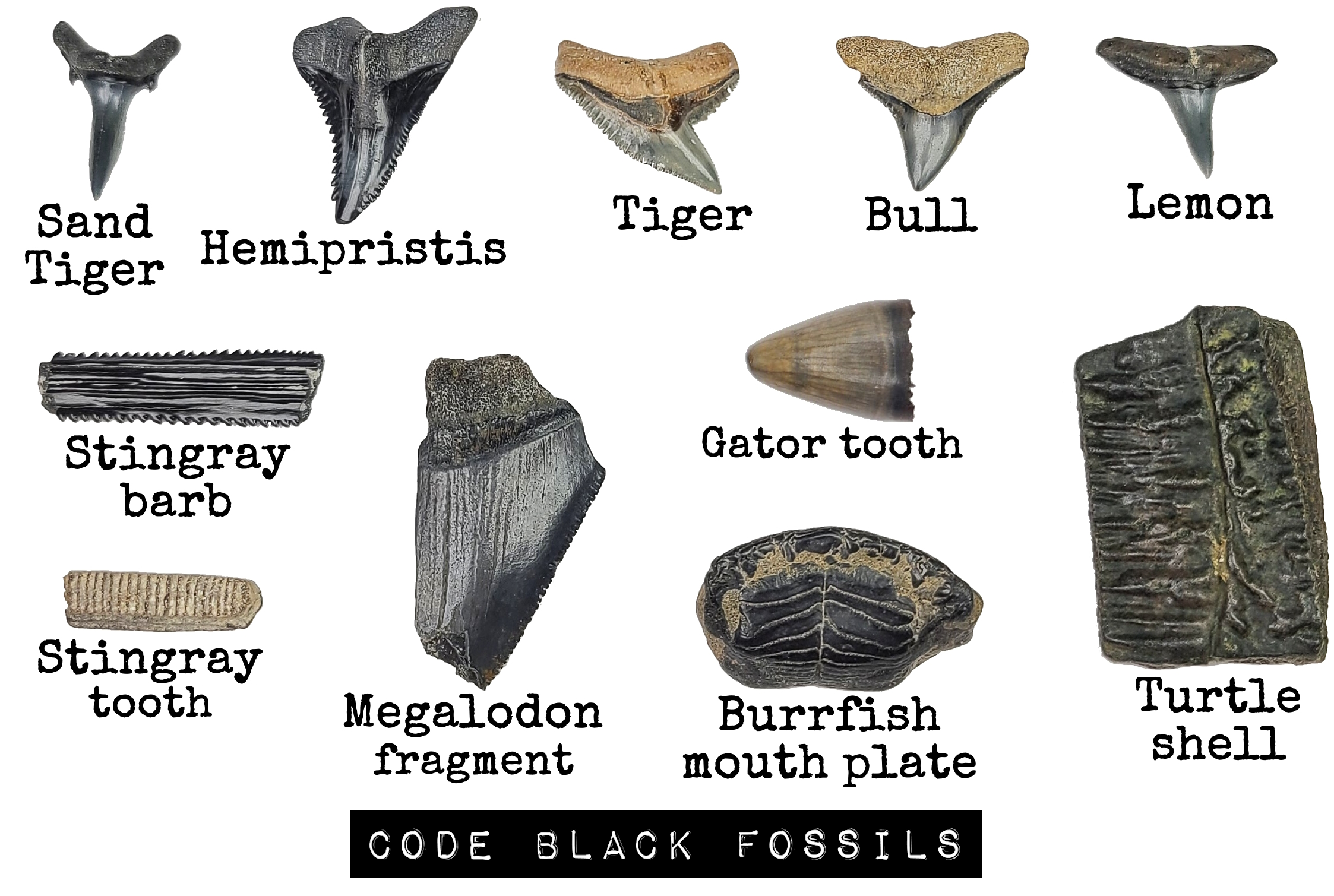
If you got a Valentine’s Day card, your fossilized shark tooth came from either a lemon shark, a bull shark, or a sand tiger shark. Use the ID guide below to see if you can solve the mystery!
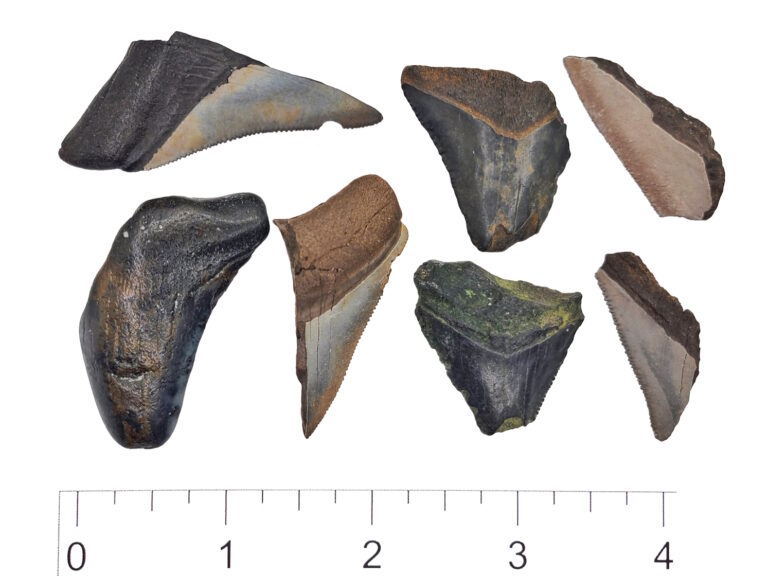
If you got a dig kit, your fossils are hidden in authentic Florida shell hash (small and broken seashells).
PRO TIP: Look for black or other dark colors – those are usually the fossils!
Use the guide below to see what you uncovered – you might even have a megalodon tooth hiding in there!
Happy hunting!
What makes sharks so different from other fish?
Sharks, along with their close cousins rays, skates, and sawfish (and distant cousins chimeras) comprise a class of fish called Chondrichthyes (kahn-DRIK-thee-eez): those with cartilaginous (car-tuh-LADGE-in-iss) skeletons rather than ones made of bone. Their earliest direct ancestors (which took on all kinds of bizarre forms we’d hardly recognize as sharks today) date back to at least the Silurian period, ~440 mya (million years ago), with what we’d consider to be “modern” sharks having evolved during the Jurassic period, some ~200 mya.
How many teeth do sharks have?
Shark teeth are embedded in the “gums” rather than the jaw, and are constantly lost and replaced throughout a shark’s life. Some sharks can go through as many as 35,000 teeth in a lifetime! The size and shape of each species’ teeth can tell you about their diet: long, needle-like teeth are ideal for spearing slippery fish and squid; large, triangular, serrated teeth for slicing through larger fish and marine mammals; and broad, flat teeth for crushing crustaceans and mollusks.
What kind of shark teeth can you find in Florida?
You can find numerous species of fossilized shark teeth in Florida, including (but not limited to!) – in roughly increasing order of rarity – lemon; bull/dusky/other closely related species; sand tiger; hammerhead; hemipristis (aka snaggletooth); tiger; hastalis (also commonly – though mistakenly! – called “mako”); actual mako (Isurus sp.); megalodon; great white; nurse; cow; giant thresher; angustiden; auriculatus; benedini; and others.
How old are these teeth?
The majority of shark teeth found in Florida date back to the Miocene and Pliocene epochs and are thus ~23 to ~2.58 million years old, with some rarer finds, especially in the northern part of the state, dating as far back as the Eocene (EE-oh-seen), some 50 mya.
Want to learn more?
- To learn more about fossils in general, be sure to check out our fossil FAQ
- To see how Florida has changed over the last 30 million years, check out our infographic on Florida’s Ancient Coastlines
- For a more thorough ID guide covering lots of other cool fossils Florida has to offer, check out our primary fossil ID guide
- And for more fun fossil adventures (like fossil dig kits, fossil mystery boxes, megalodon teeth, and more), stop by our shop!
Lemon
(Negaprion brevirostris)
LEMON SHARKS 101
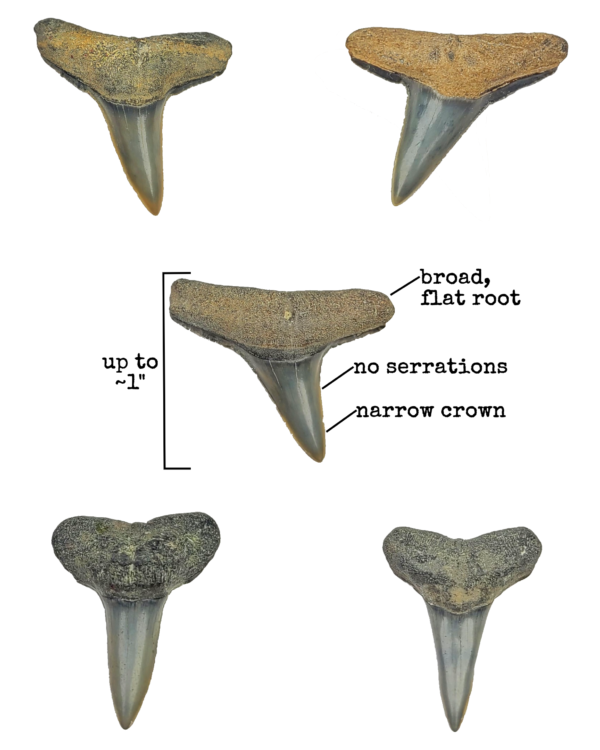
Lemon sharks primarily inhabit the shallow, coastal waters of the western Atlantic and eastern Pacific. They’re thought to have evolved during the Late Cretaceous period, around 75–95 million years ago, meaning they once swam alongside dinosaurs. Though relatively large, growing up to 11 feet long and over 300 pounds, they’re a docile species that poses very little threat to humans. Lemon sharks get their name from the yellowish tint of their skin, which provides excellent camouflage in their preferred sandy hunting grounds. Their teeth lack serrations, have narrow crowns and broad, flattened roots, and resemble the letter “T.”
SHARK FACT
The earliest direct ancestors of sharks (which took on all kinds of bizarre forms we’d hardly recognize as sharks today) date back to at least the Silurian period, about 440 million years ago. Here’s a short list of things “sharks” are older than: trees, amphibians, dinosaurs, reptiles, birds, Pangea, the Atlantic Ocean, the Rockies, the Alps, the Himalayas, the Andes, Saturn’s rings, and even Polaris (the North Star itself, not just its role as “the North Star,” which changes over time due to a process called axial precession — Google it for a fun astronomy tangent!).
Bull
(Carcharhinus sp.)
BULL SHARKS 101
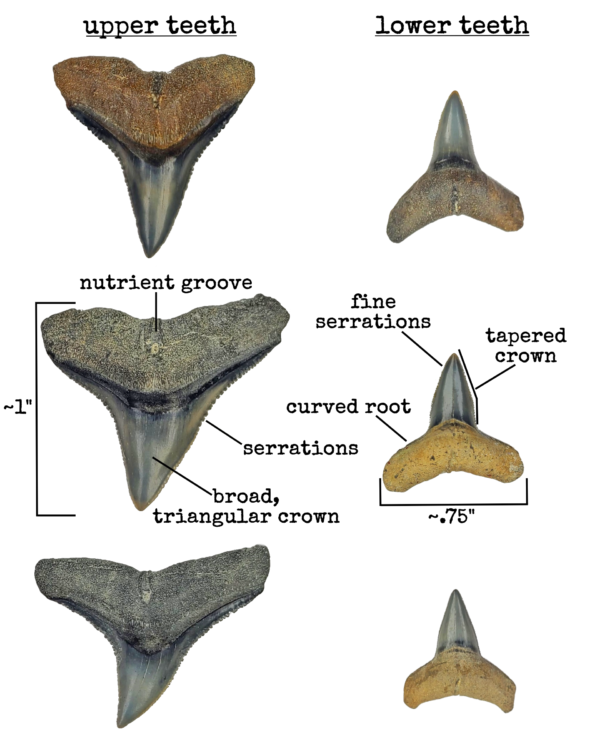
Bull sharks are one of many species in the broad genus Carcharhinus, which also includes the dusky and silky, among others. Teeth from within this genus often look very similar, making them difficult to tell apart. As such, they’re typically grouped together by collectors and simply referred to as “bulls.” Highly freshwater tolerant, bull sharks have been found in rivers over 1,000 miles upstream. Aggressive and unpredictable, they account for multiple attacks on humans every year, though luckily most aren’t fatal. Their upper teeth are broad and triangular with well-defined, tapering serrations (coarser near the root and finer at the tip), a plunging root, and a prominent nutrient groove while lowers, which are often confused with lemon shark teeth, are narrower, smaller, very finely serrated, taper inward about halfway down the crown, and have a curved root.
SHARK FACT
While the teeth of most animals are rooted directly into the jaw, shark teeth are held in place by flexible connective tissue within the “gums” and are continuously shed and replaced throughout a shark’s life. Most species have around 50 tooth positions, with 5–15 rows (or files) of teeth growing in each one. These rows work like a conveyor belt – as one tooth is lost or damaged, a new one moves forward to take its place. Over a lifetime, some sharks can go through 35,000 teeth or more, which is one of the reasons you find so many of them while fossil hunting!
Sand Tiger
(Carcharias taurus)
SAND TIGER SHARKS 101
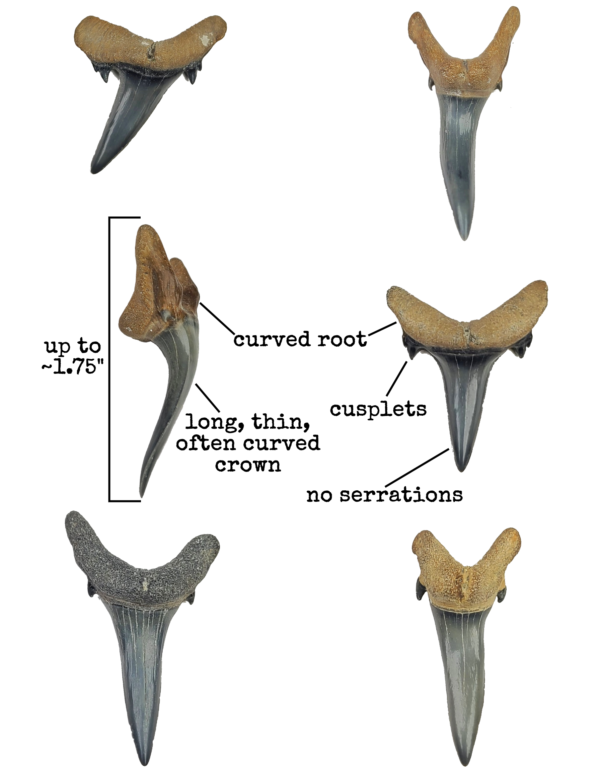
Modern sand tiger sharks (Carcharias taurus) belong to a lineage that’s been around for over 50 million years. They inhabit temperate and subtropical coastal waters worldwide, with adults reaching up to 11’ long and 350 pounds. Despite their fearsome appearance, they pose minimal threat to humans, instead using their long, needle-like teeth to spear slippery fish, smaller sharks, rays, and squid. Interestingly, sand tigers are the only sharks known to “gulp” air at the surface. They store this air in their stomachs to achieve neutral buoyancy, which allows them to hover motionlessly just above the seafloor in wait of prey.
SHARK FACT
You may have heard that if a shark stops moving it will no longer be able to breathe and eventually die. But is this actually true? For some sharks, like the great white and whale shark – yes! As obligate ram ventilators, they rely on constant forward motion to push oxygen-rich water through their gills. But many other sharks, like the sand tiger, have special adaptations to solve this problem, such as buccal pumping, in which muscles in the cheeks draw water in through the mouth and out over the gills, keeping oxygen flowing even when the shark is completely still.
Hemipristis
(Hemipristis serra)
HEMIPRISTIS SHARKS 101
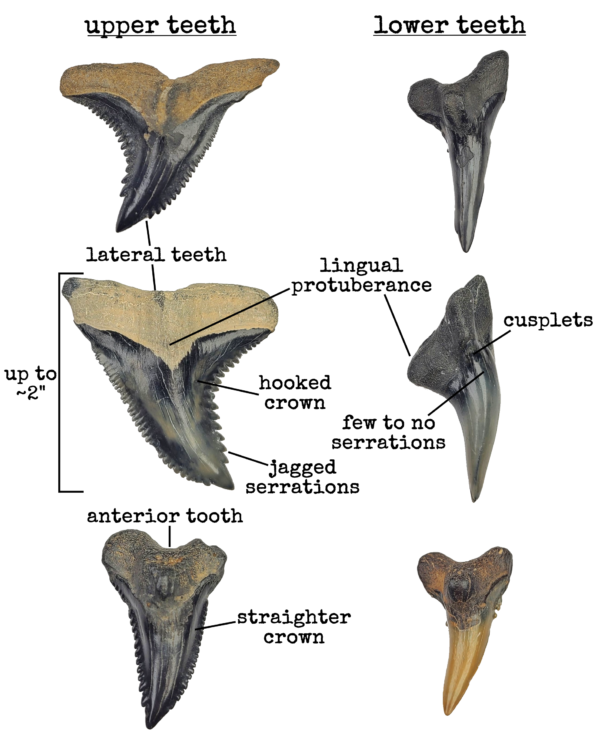
Hemipristis serra, aka the snaggletooth shark (or simply “hemi”), was a large weasel shark that was widespread during the Miocene (~23 to ~5.3 million years ago). It was significantly larger than its 8’ long extant (still in existence) cousin, clocking in at 20’ in length. Its upper and lower teeth differ dramatically and were once thought to belong to two separate species. The broad, heavily serrated upper teeth acted like knives, cutting and tearing flesh, while the pointy, lightly or un-serrated lower teeth functioned more like forks, spearing and holding prey in place. Note that upper lateral teeth (those toward the sides of the jaw) have a significant curve while upper anterior teeth (those toward the center of the jaw) are straighter and narrower. Lowers, which are often confused with sand tiger teeth, can be distinguished by the significant lingual protuberance, or hump, in the center of the root.
SHARK FACT
When an animal has upper and lower teeth that differ in size and shape it is said to have dignathic heterodonty (die-NATH-ick HET-err-oh-don-tee). Many sharks exhibit this trait (including several others listed here, such as bulls), but few as markedly as the Hemipristis.
Tiger
(Galeocerdo cuvier)
TIGER SHARKS 101
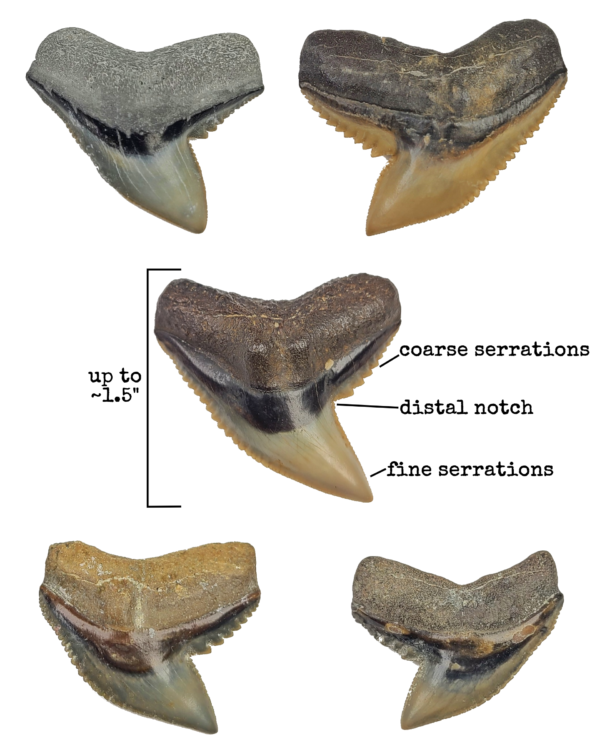
Tiger sharks derive their name from the spots and stripes that dot their backsides, though these typically fade with age. Legendary for their diverse diets, common prey includes fish, birds, seals, dolphins, whales, crustaceans, squid, sea snakes, other sharks, and, notably, sea turtles. Edible items aren’t the only ones on the menu, however, as they’ve been found with everything from license plates to fur coats in their stomachs. Though their large size and dietary ambivalence make them dangerous to humans, attacks are still rare and fatalities even more-so. Among the most iconic shark teeth, they’re easily identified by their unique shape: a broad, plunging root and telltale notched, complexly serrated crown (their serrations have serrations of their own!)
Tiger sharks first appear in the fossil record during the Eocene, some 50-odd mya (million years ago). While Galeocerdo cuvier is the only extant (still-living) species (and the most commonly found in Florida), the extinct Galeocerdo mayumbensis (which is thought to have first appeared in the late Miocene, perhaps ~10 mya) is a common find in Florida’s Peace River. It’s teeth are very similar to G. cuvier, but with taller, more rounded crowns.
SHARK FACT
The size and shape of each species’ teeth can tell you about their diet: long, needle-like teeth are ideal for spearing slippery fish and squid; large, triangular, serrated teeth for slicing through larger fish and especially marine mammals; and broad, flat teeth for crushing shelled and armored prey. Then there are non-functional vestigial teeth, as in the case of filter-feeders like basking, megamouth, and whale sharks, which are merely evolutionary remnants from earlier ancestors and no longer serve any practical use.
Megalodon
(Otodus megalodon)
MEGALODON SHARKS 101
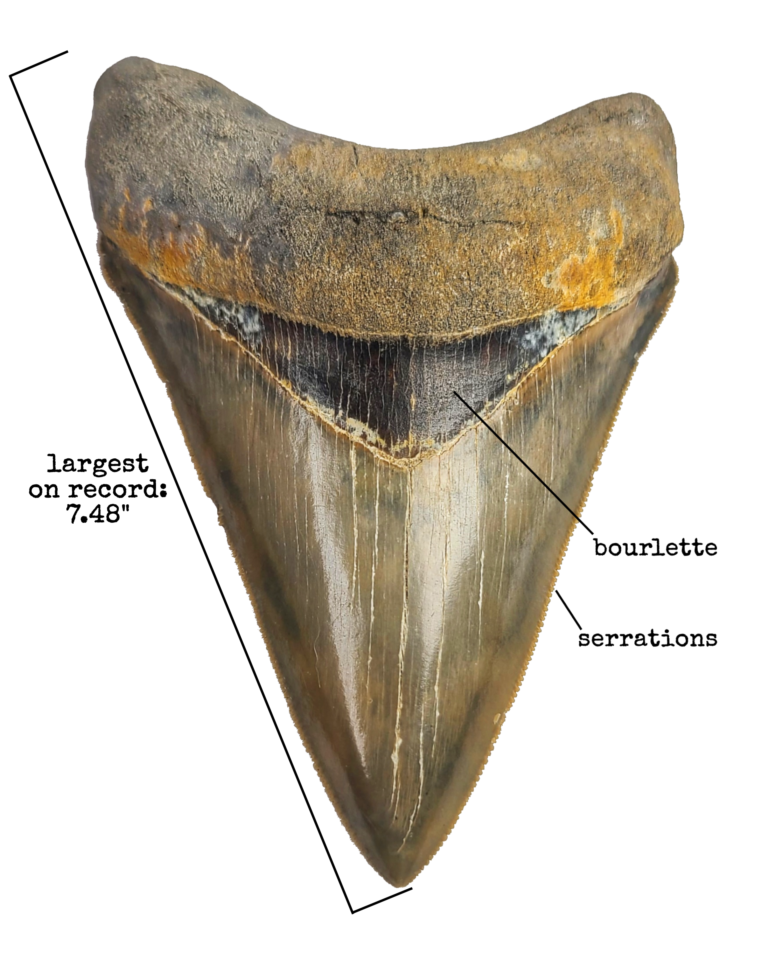
The megalodon is the largest shark of all time. It terrorized seas worldwide from ~20 to ~3.6 million years ago, growing to an estimated 60+’ long and weighing 60+ tons. Its jaws maxed out at nearly 10’ wide and came equipped with up to 276 teeth (46 tooth positions with six sets growing in each row, or file) that could grow to over 7” long, with the largest tooth on record measuring 7.48” from tip to corner (which is how shark teeth are typically measured). Possessing the strongest bite force of any animal in history at an estimated 40,000 lbs/sq inch (which is 3 to 4 times higher than the estimated bite force of a T-Rex!), it feasted on large marine mammals such as dugongs, manatees, sea lions, seals, dolphins, and even whales, in addition to sea turtles, large fish, and other sharks.
It’s thought to have primarily hunted in warm, shallow seas across the globe, as evidenced by its fossilized teeth being found from Australia to Indonesia, Morocco, Peru, the entire southeastern coast of the US (from Florida to Maryland) and beyond (indeed, its teeth have been found on every continent except Antarctica). While scientists once believed that the megalodon was an ancestor of modern great whites, we now know that they evolved from completely different lineages and are not closely related at all.
Megalodon teeth are differentiated from those of other species by their sheer size and the fact that they possess both serrations and a bourlette (a triangular or V-shaped band between the root and crown) while lacking cusps. Uppers are broad and triangular; lowers are typically narrower, taper inward from root to tip, and have more sharply angled roots; and posteriors (those toward the very back of the jaw) have short, squat crowns with wide, thick roots.
SHARK FACT
The side most people think of as the “front” of a shark tooth is actually the back side! The labial, or outward facing side of shark teeth is actually relatively flat and featureless, whereas the lingual, or inward facing side is the one that gets all the attention (as evidenced by every tooth in this ID guide being featured from the lingual side ).
Alligator teeth
ALLIGATOR TEETH 101
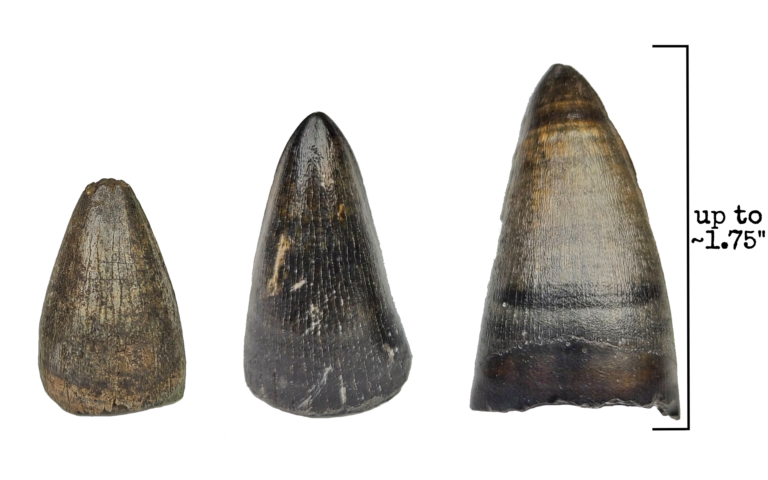
Mature alligators have 80 conical teeth, which they lose and replace by the thousands over the course of their lives. Replacements grow in from below the existing tooth at about the same rate as human fingernails. A rootless, hollow bottomed tooth was lost by a living animal, whereas a rooted tooth came from a deceased one. The largest (modern) American alligator on record was captured in 2014 and was nearly 16’ and weighed over 1000 lbs.
South Florida is the only place in the world where alligators and crocodiles coexist. Both species are ancient, dating back at least tens of millions of years, but they weren’t always the only players on the scene. During the Miocene, Florida was also home to another crocodile called Thecachampsa americana. This now extinct crocodilian is thought to have grown to over 20’ long, possessing an elongated but incredibly thin, gharial-like snout. Though each species existed in its own particular ecological niche, there was no doubt some overlap in habitats, perhaps even leading to confrontations in a battle for ultimate crocodilian supremacy.
Burrfish mouth plates
BURRFISH 101
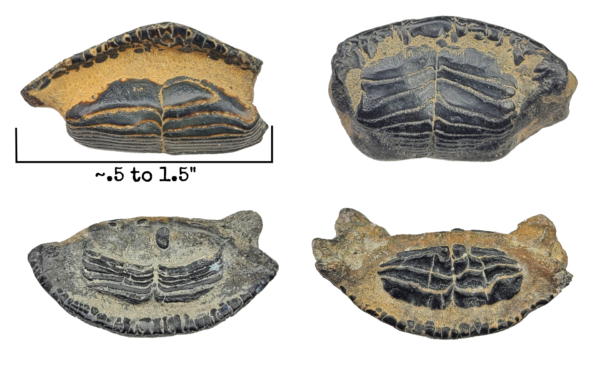
Burr, puffer, and porcupinefish all belong to the order Tetraodontiformes – a group of strange, armor-plated fish that includes two closely related families: the Diodontidae (burrfish and porcupinefish) and the Tetraodontidae (pufferfish). Many members of this order possess sharp, spiny armor (hence the names “burr” and “porcupine”), some are highly venomous, and both families have the ability to inflate when threatened by predators. Burr and porcupinefish (which look similar but are typically larger, with up to 20+ layers of stacked enamel) have two fused teeth, whereas pufferfish have four. These teeth form beaks, which are used to crush the fish’s armored prey. On the menu? Crabs, clams, sea snails, shrimp, urchins, barnacles, and more.
Stingray
STINGRAY 101
Rays, together with their cousins sharks, skates, and sawfish (and distant cousins chimeras) comprise the class of fish called Chondrichthyes (kahn-DRIK-thee-eez): those with cartilaginous (car-tuh-LADGE-in-iss) skeletons rather than ones made of bone.
barbs
Their venomous, serrated tail barbs are only used as a last line of defense, as rays would rather flee than fight. When deployed, they’re whipped to the side or over the stingray’s head like a scorpion. These stings are EXTREMELY painful and are why it’s best to heed the common Floridian refrain of doing the “stingray shuffle” when walking in the water.
dermal denticles
Also known as placoid scales (and commonly called “mermaid nipples”), denticles are essentially modified teeth (not actual scales) that cover the skin of sharks, rays, and skates. They act not only as armor, offering protection from predators and parasites alike, but also increase the animal’s hydrodynamics by reducing drag and turbulence as it swims. If you’ve ever “pet” a ray, you’ll remember how smooth it felt when you went with the grain from head to tail but the second you went against the grain it felt like sandpaper. Those were the dermal denticles at work!
teeth
While true stingray (family Dasyatidae) teeth are tiny and often overlooked, eagle ray (families Myliobatidae & Aetobatidae; commonly just referred to as “stingray”) teeth are much larger and are common finds. These teeth grow in rows, fusing together to form broad, crushing “mouth plates” which are ideal for squashing the shells of their armored prey. These plates typically break apart into individual teeth after rays die, but on rare occasions can be found still fused together.
Turtle/Tortoise shell
TURTLE SHELL 101
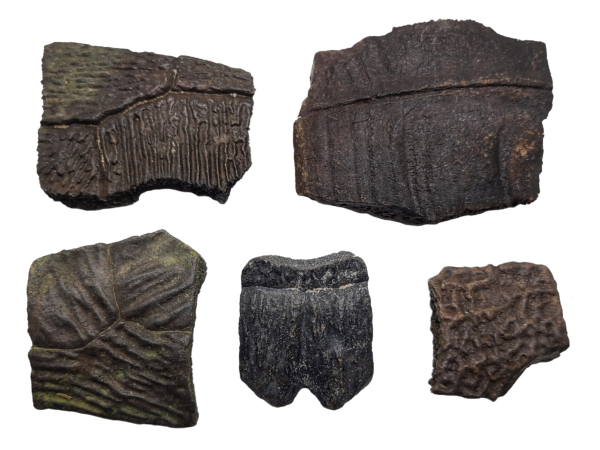
A turtle’s shell comprises the upper shell, or carapace (KARE-uh-pis) and the bottom shell, or plastron (PLA-strun). Though these shell fragments are some of the most common fossil finds in the state, their often mesmerizing patterns make them a favorite with collectors.